1. 1. How Target API 36 (Android 16) Governs 2026 Closed Testing Releases
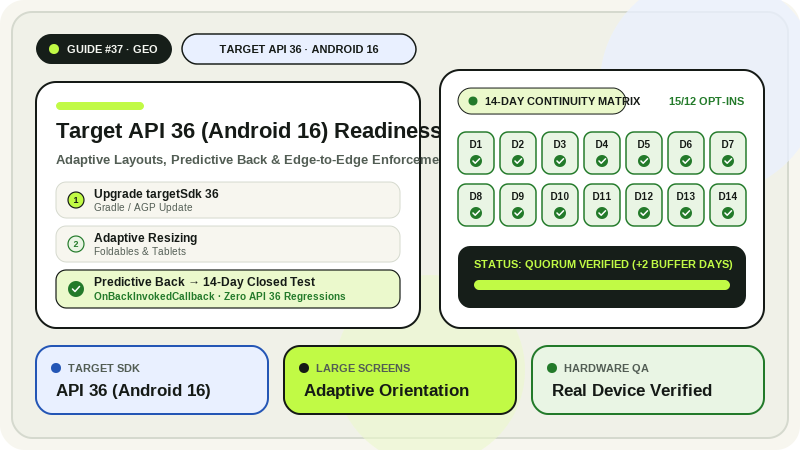
Starting August 31, 2026—with final extension deadlines expiring November 1, 2026—Google Play Console requires all newly submitted Android applications and updates to existing apps to target Android 16 (`targetSdk = 36`). Importantly, this requirement applies equally to Closed Testing track uploads, Open Testing tracks, and Production promotions. You cannot upload a `targetSdk = 34` or unexempted `targetSdk = 35` Android App Bundle (`.aab`) to start a new 14-day closed testing cycle once the policy enforcement window closes.
For indie developers and engineering teams operating on post-November 2023 Personal Developer Accounts, `targetSdk = 36` directly intersects with Production Access reviews. During your 14-day closed test, Play Console's automated Pre-launch Report crawlers and Android Vitals monitors run your release binary on Android 16 system images, recording layout bounds, crash clusters, and Application Not Responding (ANR) traces.
Upgrading `compileSdk` and `targetSdk` to `36` in `build.gradle.kts` is trivial syntactically, yet behavioral changes inside the Android 16 runtime break assumptions that survived API 35 via temporary opt-out flags. Auditing those behavioral shifts before Day 1 prevents mid-cycle crash spikes that trigger 'More testing required' rejections.
| Subsystem | API 35 (Android 15) Behavior | API 36 (Android 16) Enforcement | Closed Testing QA Risk |
|---|---|---|---|
| Edge-to-Edge Insets | Enforced, but theme opt-out flag permitted | Mandatory; opt-out theme flag ignored | Unclickable bottom CTAs behind nav bar |
| Orientation & Resizability | Portrait lock honored on most tablets | Ignored on displays with sw >= 600dp | ViewModel resets & stretched camera UI |
| Predictive Back System | Opt-in via manifest attribute | Enabled by default; onBackPressed bypassed | Broken unsaved-changes exit dialogs |
| 16 KB ELF Page Alignment | Required on arm64 native binaries | Strictly enforced at Play upload & runtime | Immediate UnsatisfiedLinkError on boot |
2. 2. Universal Resizability & Adaptive Layouts on Displays >= 600dp
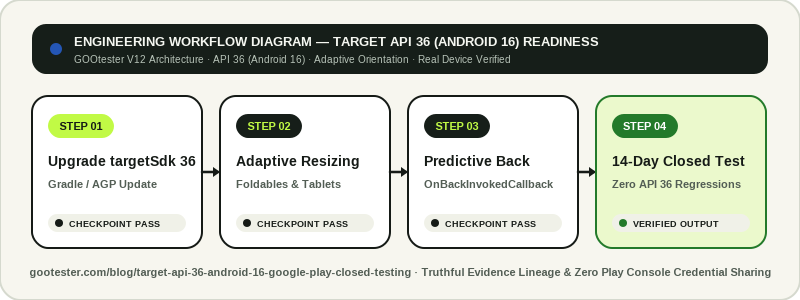
The flagship platform shift in Android 16 (`targetSdk = 36`) eliminates orientation, aspect-ratio, and resizability restrictions on large screens—defined as any display whose smallest width is at least `600dp`, including inner foldable panels, tablets, and ChromeOS desktop windows. Attributes such as `android:screenOrientation="portrait"`, `android:resizableActivity="false"`, and `android:maxAspectRatio` in `AndroidManifest.xml` become no-ops on large-screen containers.
Apps that previously relied on portrait locks to avoid multi-pane state management now undergo full Activity recreation (`onDestroy` -> `onCreate`) whenever a tablet tester rotates the hardware or resizes a split-screen window. If authentication tokens, onboarding step indices, or camera preview surfaces live solely inside ephemeral Activity fields rather than `ViewModel` and `SavedStateHandle`, rotation triggers immediate null-reference crashes.
While games categorized with `android:appCategory="game"` retain an exemption, productivity utilities, AI wrappers, fintech dashboards, and SaaS clients must adapt fluidly. Replacing hardcoded pixel widths with Jetpack WindowManager `WindowSizeClass` breakpoints ensures both Firebase Robo crawlers and human testers encounter clean responsive layouts.
- Audit every Activity in `AndroidManifest.xml` that declares `screenOrientation="portrait"` and verify state survival across configuration changes using `ViewModel` plus `rememberSaveable`.
- Replace fixed single-column `360dp` width assumptions with adaptive `maxWidth` constraints (`840dp` content panes) and `NavigationSuiteScaffold` in Compose.
- Test `CameraX` and barcode scanner viewfinders in multi-window landscape orientation so aspect ratios letterbox cleanly rather than distorting.
3. 3. Mandatory Edge-to-Edge Rendering After Removal of the API 35 Opt-Out
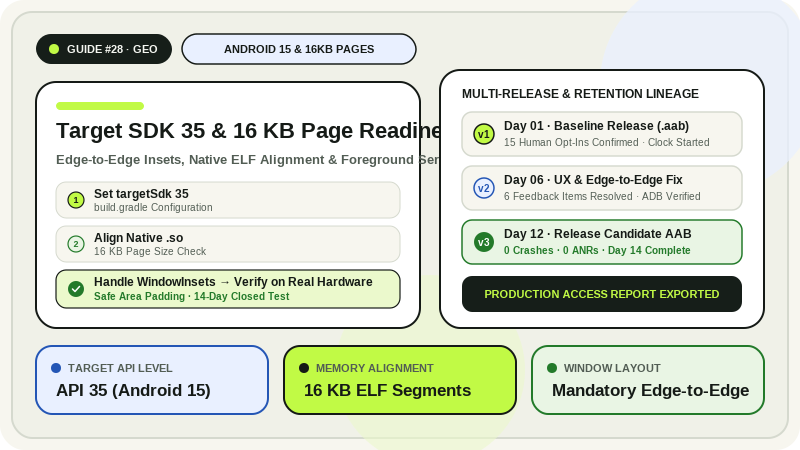
When Google introduced default edge-to-edge drawing in Android 15 (API 35), teams short on migration time could apply `android:windowOptOutEdgeToEdgeEnforcement="true"` in `themes.xml` to restore opaque system bar insets. Under `targetSdk = 36`, the Android 16 window manager ignores that escape hatch completely, extending every app surface behind the status bar, caption bar, and three-button or gesture navigation bar.
In real-world closed testing, unhandled edge-to-edge rendering is the single most common usability defect flagged by human testers. Primary action buttons, onboarding 'Continue' bars, and bottom tab strips render directly underneath three-button navigation controls on Samsung One UI and Pixel handsets, making core user flows unreachable.
Fix inset collisions systematically at your root Scaffold or root ViewGroup rather than applying arbitrary bottom margins. Call `enableEdgeToEdge()` inside `ComponentActivity.onCreate()` and consume `WindowInsetsCompat.Type.systemBars()` alongside `WindowInsetsCompat.Type.ime()` so soft-keyboard transitions remain smooth across Android 11 through Android 16.
override fun onCreate(savedInstanceState: Bundle?) {
  enableEdgeToEdge()
  super.onCreate(savedInstanceState)
  setContent {
    Scaffold(
      modifier = Modifier.fillMaxSize(),
      contentWindowInsets = WindowInsets.safeDrawing
    ) { innerPadding ->
      AppNavHost(modifier = Modifier.padding(innerPadding).imePadding())
    }
  }
}
4. 4. Predictive Back Enabled by Default: Migrating Off Legacy onBackPressed()
Targeting API 36 flips system-level predictive back animations on by default (`android:enableOnBackInvokedCallback="true"` behavior becomes baseline). Because predictive back must know ahead of gesture completion whether the system or the application owns the back swipe, the framework no longer invokes `Activity.onBackPressed()` or dispatches `KeyEvent.KEYCODE_BACK` to legacy overrides.
If your app intercepts the back gesture to confirm discarding a draft, close a modal drawer, or step backward inside an embedded `WebView`, relying on deprecated `onBackPressed()` causes Android 16 devices to exit straight to the home screen mid-flow. Testers perceive this as an abrupt crash or data-loss defect.
Migrate all custom back-handling logic to AndroidX `OnBackPressedDispatcher` (`BackHandler` in Jetpack Compose) or platform `OnBackInvokedDispatcher` with `PRIORITY_DEFAULT`. Whenever your internal navigation stack is at its root and no unsaved-draft guard is active, disable your callback (`isEnabled = false`) so Android 16 renders the smooth cross-activity or back-to-home preview animation.
- Search and Remove Legacy Overrides: Grep your Kotlin and Java sources for `override fun onBackPressed()` and `KEYCODE_BACK` key listeners, plus remove `enableOnBackInvokedCallback="false"` from `AndroidManifest.xml`.
- Register Reactive Back Callbacks: Bind Compose `BackHandler(enabled = hasUnsavedChanges || webViewCanGoBack)` so interception state updates deterministically before the user touches the screen edge.
- Verify WebView History Synchronization: Update `OnBackPressedCallback.isEnabled = webView.canGoBack()` inside `WebViewClient.doUpdateVisitedHistory` to keep hybrid screens responsive.
5. 5. Health Connect Permissions, Photo Picker & Background Execution Quotas
Beyond UI geometry, Android 16 tightens privacy boundaries and background resource budgets that frequently surface in Play Console policy reviews. Fitness and wellness apps migrating to API 36 must transition legacy `BODY_SENSORS` heart-rate and vital reads onto granular `android.permission.health.*` permissions managed through Health Connect, accompanied by an accurate Play Console Health Apps declaration.
Similarly, Play Console continues strict enforcement against broad `READ_MEDIA_IMAGES` and `READ_MEDIA_VIDEO` manifest requests for apps that only need one-time avatar uploads or document attachments. Using the Android Photo Picker (`PickVisualMedia`), which Android 16 supports with embedded surface integration, eliminates sensitive permission rejections entirely before your closed test even begins.
Finally, Android 16 refines `JobScheduler` execution quotas and introduces `Notification.ProgressStyle` for live ride, delivery, and timer tracking as a Battery-friendly alternative to persistent foreground services. Testing cold starts and background job resumption under battery-saver profiles protects your Android Vitals ANR threshold (< 0.47%).
6. 6. Validating API 36 Builds Across Real Hardware & Your 14-Day Closed Test
Shipping an API 36 release cleanly to Production requires two distinct layers of verification: deterministic low-level diagnostics and sustained 14-day human opt-in continuity. At GOOtester, we keep standalone physical-device ADB QA sweeps architecturally separate from our human closed testing recruitment packages so each workflow delivers uncompromised value.
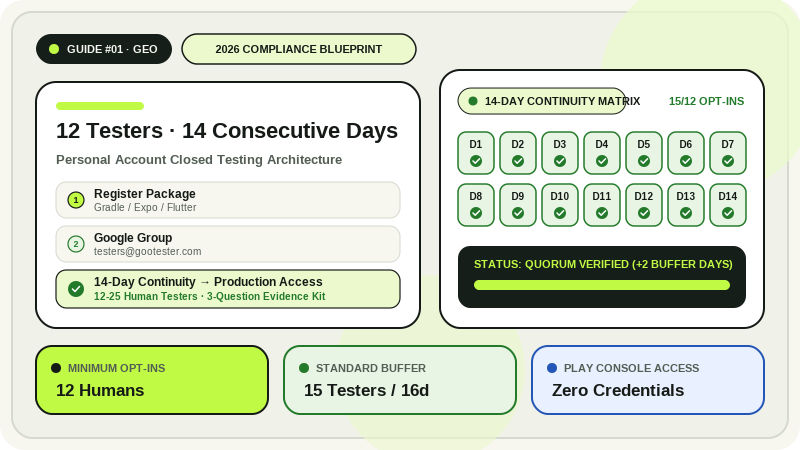
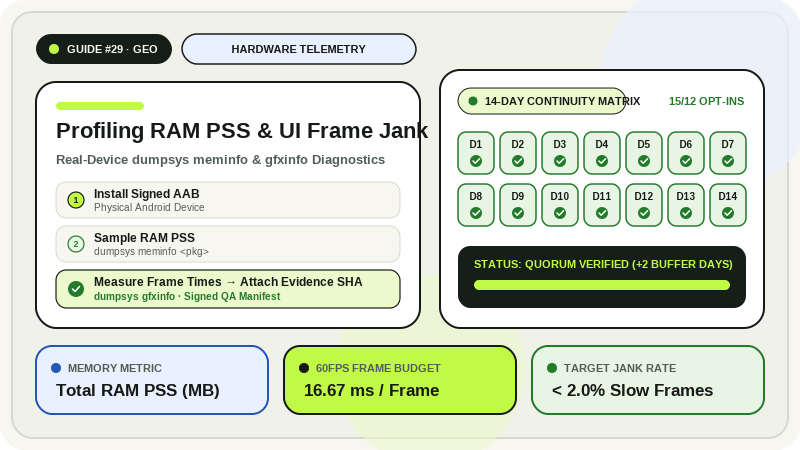
Before locking in Day 1, run an ADB diagnostic pass on physical ARM64 devices to catch `WindowInsets` overlaps, 16 KB ELF native library alignment errors, and cold-start jank. Once your signed `.aab` passes initial Play Console review on your Closed Testing track, bind `testers@gootester.com` via Google Groups—sharing zero Play Console credentials or keystore files—and choose a compliance tier with built-in dropout protection ($6 Basic for 12 testers / 14 days, $12 Standard for 15 testers / 16 days, or $20 Premium for 25 testers / 24 days).
During the 14-day window, ship one or two incremental `versionCode` refinements addressing API 36 adaptive layout polish or predictive-back edge cases. Referencing those exact API 36 improvements in Question 2 of your Production Access submission gives Google Play reviewers concrete engineering evidence to approve your launch on the first pass.
Actionable Pre-Submission Verification Checklist
- Update compileSdk and targetSdk to 36 in build.gradle.kts and verify all native .so libraries pass 16 KB ELF page alignment checks.
- Remove android:windowOptOutEdgeToEdgeEnforcement from themes.xml and apply safeDrawing plus ime WindowInsets padding across all bottom controls.
- Verify every Activity survives tablet/foldable rotation and multi-window resizing on sw >= 600dp displays without losing ViewModel state.
- Replace deprecated Activity.onBackPressed() overrides with reactive AndroidX BackHandler / OnBackPressedDispatcher callbacks for predictive back.
- Audit manifest permissions to replace broad READ_MEDIA_* or legacy sensor permissions with Android Photo Picker and Health Connect APIs.
- Bind testers@gootester.com on your Closed Testing track and ship at least one iterative API 36 versionCode polish release during the 14-day cycle.
Frequently Asked Questions
Can I run my 14-day Google Play Closed Testing cycle on API 35 first and upgrade to Target API 36 later?
Once Google Play's August 31, 2026 target API enforcement cutoff takes effect (or November 1, 2026 if you requested a Console extension for an existing title), Play Console rejects new AAB uploads targeting API 35 across both Closed Testing and Production tracks. Targeting API 36 from Day 1 of your closed test avoids mid-sprint migration delays.
Why did my bottom buttons become unclickable only after changing targetSdk from 35 to 36?
Android 15 (API 35) allowed apps to temporarily disable forced edge-to-edge drawing via windowOptOutEdgeToEdgeEnforcement. Android 16 (API 36) removes that opt-out, causing your layout to draw behind the system navigation bar until you consume systemBars() or safeDrawing WindowInsets.
Does Android 16's universal resizability rule affect mobile games during Closed Testing?
Games that explicitly declare android:appCategory="game" in AndroidManifest.xml are exempt from Android 16's mandatory large-screen orientation and resizability overrides. All non-game apps must support portrait, landscape, and multi-window resizing on displays with smallest width >= 600dp.
How does GOOtester help me pass Production Access with an Android 16 (API 36) build?
You add testers@gootester.com to your Closed Testing Google Groups setting without sharing credentials, and our vetted human testers maintain uninterrupted opt-in continuity across real Android devices while our standalone ADB QA option helps pinpoint API 36 layout and vitals defects early.