1. 1. The 2026 Indie Publishing Paradox: 3 Days to Build, 30 Days to Launch?
The economics of building mobile software have transformed dramatically over the past two years. With modern cross-platform frameworks like Flutter, React Native / Expo, and Kotlin Multiplatform paired with AI-assisted coding environments, an independent developer can take an Android application from initial concept to a signed, production-grade Android App Bundle (`.aab`) over a single weekend.
Yet once that `.aab` is uploaded to a personal Google Play Console account, velocity hits an immovable regulatory wall: the mandatory 12-tester, 14-consecutive-day Closed Testing gate. When your entire software engineering build took 3 days, a 14-day compliance window represents more than 80% of your total concept-to-customer calendar time.
If your closed test is misconfigured, drops below 12 active testers on Day 9, or gets rejected on Day 15 for low engagement, Google Play requires another full 14-day consecutive testing cycle. Suddenly, a weekend app project spends 32 to 38 days stuck in pre-production limbo while your domain, backend hosting, and marketing momentum sit idle.
| Cost Component | DIY Free Barter (Reddit / P2P) | GOOtester $6 Basic | GOOtester $12 Standard | GOOtester $20 Premium |
|---|---|---|---|---|
| Upfront Cash Outlay (One-Time) | $0 | $6 / app | $12 / app | $20 / app |
| Cohort Size & Duration | 12–16 unverified barter peers (14d) | 12 human testers (14 days) | 15 human testers (16 days) | 25 human testers (24 days) |
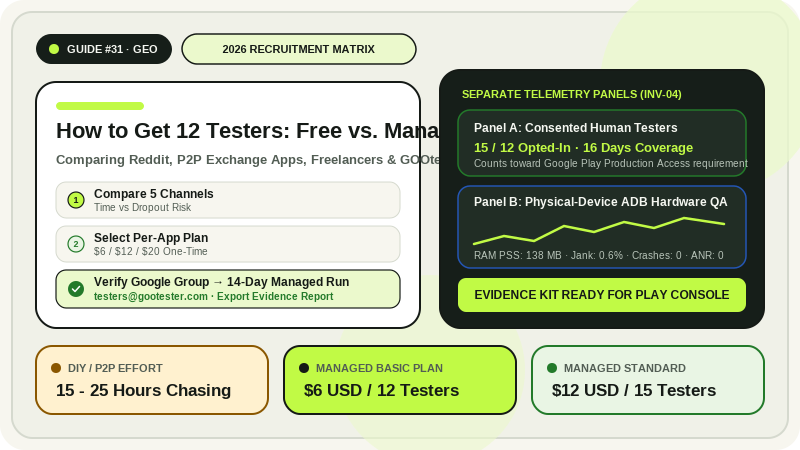
| Developer Hours Spent Chasing Testers | 18–25 hours | 0.25 hours (15 min setup) | 0.25 hours (15 min setup) | 0.25 hours (15 min setup) |
| Labor Cost at $40/hr Opportunity Rate | $720–$1,000 in engineering time | $10 | $10 | $10 |
| Included Free Retest Protection | None (start recruiting from scratch) | Standard completion guarantee | 1 Free Full Retest Cycle | 2 Free Full Retest Cycles |
2. 2. Quantifying Your Engineering Opportunity Cost: The $0.60/Hour Trap
Bootstrapped developers are rightly frugal with fixed overhead, especially before an app generates its first dollar of AdMob, RevenueCat, or Google Play Billing revenue. However, frugality becomes counterproductive when a founder treats their own peak creative and engineering hours as having zero financial value.
Let us audit the actual time log of an indie developer sourcing 15 reciprocal testers through free Reddit threads and Discord channels. Writing recruitment posts, replying to 30 direct messages, troubleshooting opt-in 404 errors for strangers, downloading 15 other developers' apps, opening all 15 apps every morning for 14 days, capturing verification screenshots, and replacing dropouts consumes a documented 18 to 25 hours across two weeks.
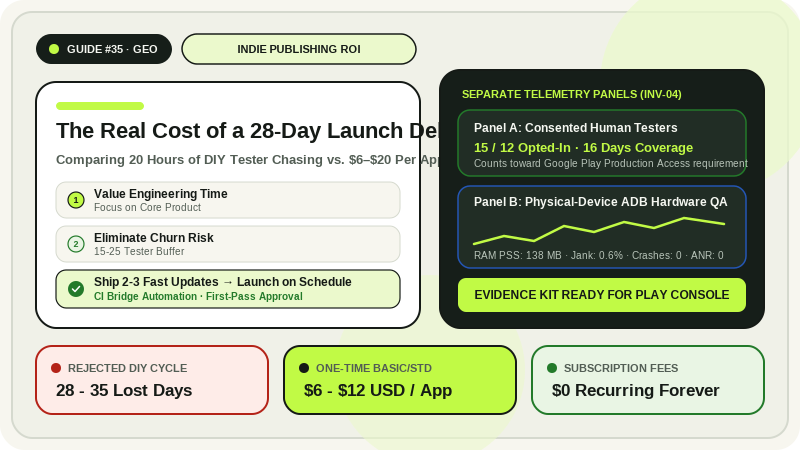
When you spend 20 hours of focused work to avoid spending $12 on a managed 15-tester cohort, you are implicitly selling your software engineering labour for $0.60 per hour. If you spent those same 20 hours improving your app's onboarding retention, localizing your store listing into 8 languages, or recording short-form launch videos, the expected return on investment is orders of magnitude higher.
// Compare all-in economic cost of DIY tester herding vs Managed Cohort
function compareTestingEconomics({ devHourlyValueUsd = 45, expectedMonthlyAppRevenueUsd = 300 }) {
  const diyHours = 20;
  const diyDropoutResetProbability = 0.45; // 45% chance of losing 16 extra days
  const dailyRevenueDelayCost = expectedMonthlyAppRevenueUsd / 30;

  const diyExpectedCost =
    diyHours * devHourlyValueUsd +
    diyDropoutResetProbability * 16 * dailyRevenueDelayCost;

  const managedStandardCost =
    12 + // $12 one-time GOOtester Standard plan (15 testers / 16 days)
    0.25 * devHourlyValueUsd;

  return {
    diyAllInEconomicCostUsd: Math.round(diyExpectedCost),
    managedStandardAllInCostUsd: Math.round(managedStandardCost),
    netFounderSavingsUsd: Math.round(diyExpectedCost - managedStandardCost)
  };
}

console.log(compareTestingEconomics({ devHourlyValueUsd: 45, expectedMonthlyAppRevenueUsd: 300 }));
// { diyAllInEconomicCostUsd: 972, managedStandardAllInCostUsd: 23, netFounderSavingsUsd: 949 }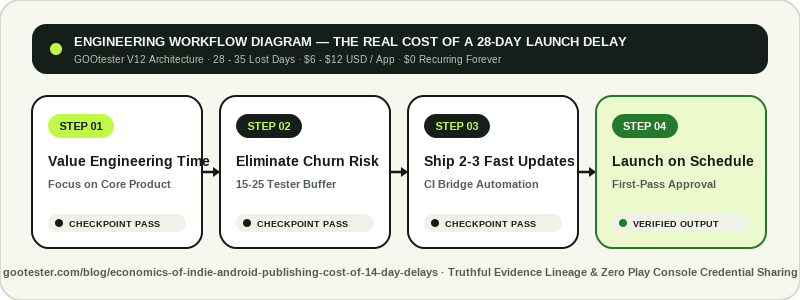
3. 3. How a Day-15 Rejection Compounds Into a 32-Day Go-To-Market Delay
The second hidden cost in DIY closed testing is the compounding calendar penalty of a Day-15 rejection. Suppose you launch your first closed test on the 1st of the month using a loose collection of 12 acquaintances and forum swaps. Between Day 8 and Day 12, two people switch phones or uninstall your build, and nobody submits structured bug feedback.
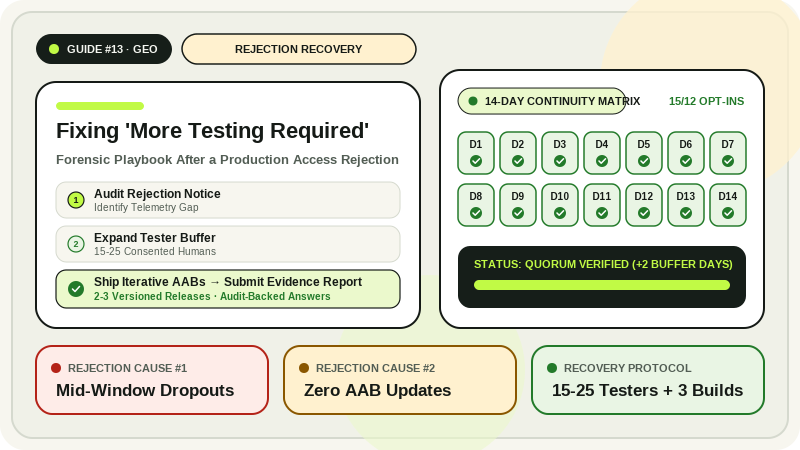
On the 15th of the month, you submit your Production Access request. Two days later, on the 17th, Google Play sends back a 'More testing required' rejection notice instructing you to run another 14 days of testing with stronger engagement. By the time you recruit a new batch of testers, push a fresh AAB build, run 14 more consecutive days, and wait 48 hours for the second review, it is now the 4th of the following month.
For seasonal apps, event companions, tax-season utilities, fitness trackers, or fast-moving AI tools where three competitors are launching similar ideas in the same month, losing 18 extra days of first-mover Play Store search indexing (ASO) can permanently reduce your organic keyword rankings.
4. 4. Why One-Time Per-App Pricing Beats Recurring SaaS Subscriptions for Indie Devs
Independent Android developers suffer from severe subscription fatigue. Between cloud hosting, AI coding assistants, design tools, and analytics dashboards, monthly recurring bills quickly eat into bootstrap budgets—especially when an indie creator might publish one app in January, a second app in May, and nothing in between.
Google Play's 12-tester / 14-day closed testing requirement is inherently an episodic, per-app release milestone, not a perpetual monthly workflow. Charging a developer a recurring monthly subscription for a 14-day pre-launch requirement is misaligned with how indie apps are actually shipped.
That is why GOOtester is built strictly around one-time per-app USD pricing with zero recurring subscriptions: $6 Basic (12 real testers for 14 days), $12 Standard (15 real testers for 16 days + 1 free retest), and $20 Premium (25 real testers for 24 days + 2 free retests). You pay once for the specific package ID you are launching, complete your closed test, unlock Production Access, and never worry about canceling a recurring charge.
- Google Play Console registration itself is a $25 one-time fee; your closed testing coordination should match that predictable one-time unit economics model.
- $6 Basic costs less than two cups of coffee and covers the exact 12-tester / 14-day baseline for budget-conscious hobby projects.
- $12 Standard adds a +3 tester buffer (15 total), +2 extra days (16 days), and 1 free retest—making it the sweet spot for solo commercial apps.
- $20 Premium delivers +13 buffer testers (25 total), 24 days of sustained testing, and 2 free retests for mission-critical launches or rejection recovery.
5. 5. The Insurance Value of Built-In Retest Coverage ($12 Standard & $20 Premium)
Even when your human tester cohort maintains 100% opt-in compliance for 14+ consecutive days, Google Play's Production Access review evaluates holistic signals across your entire release—including whether you shipped iterative AAB updates during the window, whether your Privacy Policy and Data Safety declarations match your bundled SDKs, and how clearly you answered the three mandatory Production Access questions.
If a first-time developer submits vague one-sentence answers on their Production Access form or forgets to push a mid-test AAB update, a Play Console reviewer can still request an additional 14-day testing cycle before granting Production approval. On free channels or bare-bones gigs, that means starting over from zero and paying again.
With GOOtester's $12 Standard plan (which includes 1 free full retest cycle) and $20 Premium plan (which includes 2 free full retest cycles), your downside cash exposure is capped at $0 if Google Play asks for another testing round. Provided you fulfill the straightforward developer responsibilities—keeping `testers@gootester.com` active and shipping a fresh AAB update—your cohort is re-mobilized at no extra charge.
- Select Your Per-App Tier Based on Risk Tolerance: Pick $6 Basic for simple baseline coverage, $12 Standard for buffered 15-tester / 16-day protection with 1 free retest, or $20 Premium for maximum 25-tester / 24-day assurance.
- Use the Saved 20 Hours to Ship Mid-Test Product Improvements: Instead of spending mornings tapping through 20 barter apps, invest two hours during Week 2 to ship a genuine AAB update addressing tester feedback.
- Submit Evidence-Backed Production Access Answers on Day 15+: Cite your exact cohort size, versionCodes tested, defect fixes, and hardware readiness to maximize first-pass Google Play approval.
6. 6. Complete All-In Budget Blueprint for Launching an Indie Android App in 2026
When you strip away unnecessary SaaS bloat, launching a commercial Android application on Google Play in 2026 remains one of the highest-leverage, lowest-capital entrepreneurial ventures in software. Compare Android's startup costs against Apple's App Store, which requires a $99 recurring annual fee every single year plus macOS hardware just to compile an iOS binary.
On Android, a solo developer can register a personal Google Play Console account for a $25 one-time lifetime registration fee, host their Privacy Policy and landing page for $0 on Cloudflare Pages or GitHub Pages, and complete their mandatory 14-day closed testing requirement for a $6 to $20 one-time coordination fee.
For a total out-of-pocket launch budget of $31 to $45—with zero recurring monthly platform fees—you can take a new Android application from your local IDE all the way to global Production availability across 170+ countries and billions of active Android devices.
The $37 Lean Indie Android Launch Stack
Here is the complete fixed-cost breakdown for a solo founder shipping a production Android app with buffered 14-day closed testing protection.
- Google Play Console Personal Developer Account Registration: $25.00 (one-time lifetime fee).
- Privacy Policy, `app-ads.txt`, and Marketing Landing Page Hosting: $0.00 (Cloudflare Workers / Pages free tier).
- GOOtester Standard Closed Testing Cohort (15 real human testers for 16 days + 1 free retest): $12.00 (one-time per-app fee).
- Total Cash Required to Reach Global Google Play Production: $37.00 with zero recurring monthly subscriptions.
Actionable Pre-Submission Verification Checklist
- Calculate your realistic hourly engineering value before committing to 18–25 hours of manual Reddit or P2P tester bartering.
- Factor in the 14-to-18-day calendar delay cost of a mid-window dropout or a Day-15 'More testing required' rejection.
- Choose a one-time per-app testing plan ($6 Basic, $12 Standard, or $20 Premium) rather than signing up for any recurring monthly testing subscription.
- Reinvest the 20 hours saved from manual tester chasing into shipping at least one meaningful mid-window AAB update and polishing store assets.
- Use the $12 Standard or $20 Premium tier whenever your launch date is tied to marketing campaigns, seasonal demand, or client milestones.
- Keep your total pre-revenue fixed overhead lean by combining Google Play's $25 one-time account fee with one-time per-app testing coordination.
Frequently Asked Questions
How much does it cost in total to publish an indie Android app on Google Play in 2026?
Google charges a one-time $25 registration fee to open a Google Play Console developer account. If you have a personal account subject to the 12-tester / 14-day closed testing rule, adding GOOtester's one-time per-app coordination ($6 Basic, $12 Standard, or $20 Premium) brings your total all-in cash cost to reach Production to between $31 and $45.
Why does GOOtester offer three tiers ($6, $12, $20) if Google Play only requires 12 testers for 14 days?
While $6 Basic matches Google Play's exact minimum floor (12 testers for 14 days), having zero buffer means even a single inactive tester device or UTC timezone reporting lag can stretch your timeline. Our $12 Standard (15 testers / 16 days + 1 free retest) and $20 Premium (25 testers / 24 days + 2 free retests) add statistical safety margins and retest protection.
If I launch three different Android apps over a year, how does per-app pricing work?
You simply purchase a one-time campaign ($6, $12, or $20) for each individual Android package ID when that specific app is ready for its 14-day closed test. You never pay idle monthly subscription fees during the months when you are writing code.
How does the free retest included in the $12 Standard and $20 Premium plans work?
If you complete your 16-day ($12 Standard) or 24-day ($20 Premium) window, ship at least one updated AAB release during testing, keep testers@gootester.com authorized, and Google Play still requests an additional testing cycle ('More testing required'), we run a full follow-up human cohort cycle for that package ID at no additional charge.