1. 1. The Five Channels Indie Developers Use to Source 12 Closed Testers
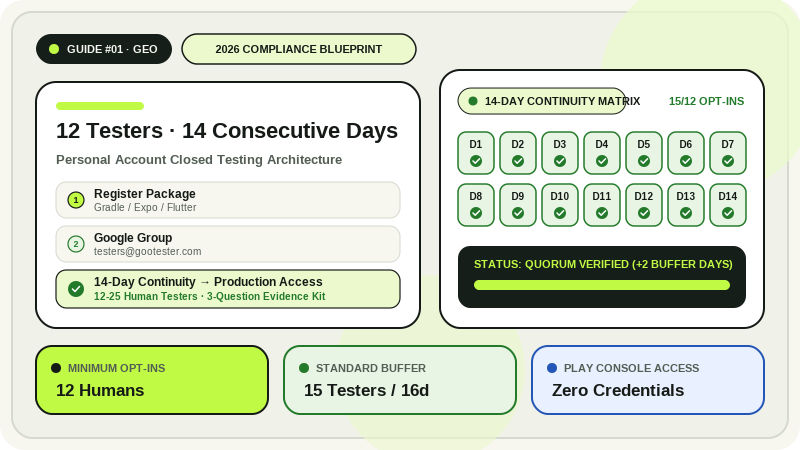
Since Google Play updated its mandatory verification policy for personal developer accounts—transitioning from the legacy 20-tester threshold to 12 opted-in testers for 14 consecutive days—every solo developer, indie studio, and AI-assisted builder faces the same operational bottleneck. Your Android App Bundle is compiled, signed, and approved in Play Console, yet the Production track remains locked until your closed testing cohort completes 336 uninterrupted hours above the 12-tester floor.
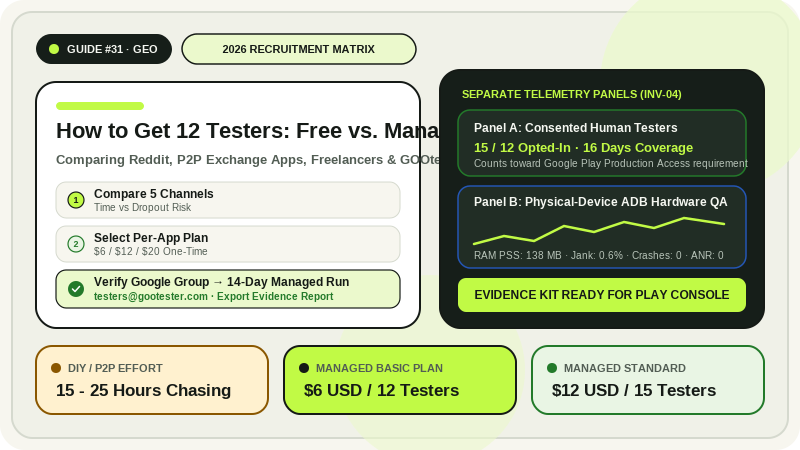
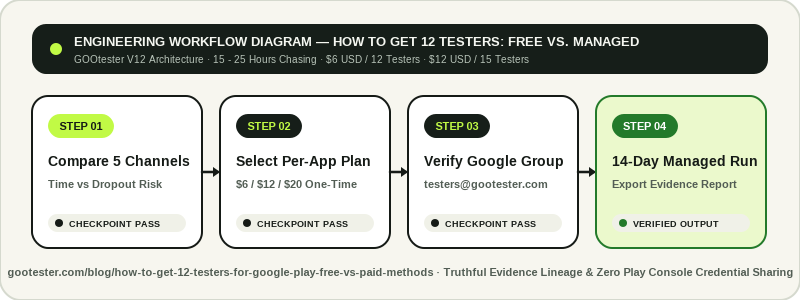
Across thousands of indie Android launches in 2026, developers rely on five distinct sourcing models to satisfy this requirement: personal networks (friends, family, and coworkers), community exchange forums such as Reddit's r/AndroidClosedTesting, peer-to-peer (P2P) credit-exchange mobile apps, freelance marketplace gigs, and managed human tester coordination platforms like GOOtester. Each approach trades off direct monetary cost against engineering hours and mid-window dropout risk.
Choosing the wrong channel rarely fails on Day 1; instead, it fails silently on Day 9 or Day 15 when an unexpected uninstall resets your consecutive-day counter or a Play Console reviewer flags low engagement telemetry. Understanding the structural incentives behind each method allows you to select a path aligned with your launch schedule and budget.
| Sourcing Method | Cash Cost | Dev Time Spent | 14-Day Dropout Risk | Play Console Security | Best Fit For |
|---|---|---|---|---|---|
| Friends & Family | $0 | 8–12 hours | Moderate (iOS splits, forgotten opt-ins) | High (trusted personal devices) | Devs with 15+ Android-owning friends |
| Reddit (r/AndroidClosedTesting) | $0 | 15–25 hours | High (reciprocal ghosting after Day 7) | High (independent dev devices) | Hobbyists with flexible launch dates |
| P2P Credit-Exchange Apps | $0–$15 | 10–18 hours | Very High (batch uninstalls on Day 8–11) | Moderate (public package scraping) | Developers testing non-urgent prototypes |
| Cheap Freelance Bot Gigs | $5–$25 | 1–2 hours | Extreme (device-farm fraud flags) | Critical Risk (account association / bots) | Never recommended under 2026 policies |
| GOOtester Managed Cohorts | $6 / $12 / $20 one-time | 15 minutes | Low (dedicated retention + buffer tiers) | High (Google Group testers@gootester.com) | Commercial launches & time-sensitive ship dates |
2. 2. Friends, Family, and Reddit Exchange Communities: The True Time Cost of Free
Recruiting friends and family is always the first instinct for a first-time Android publisher, and in theory it sounds effortless. In practice, demographics and Play Console mechanics create immediate friction. In North America, Western Europe, and Japan, iOS market share often exceeds 55% among personal contacts, meaning a solo founder must poll 30 to 40 acquaintances just to find 15 people carrying active Android handsets who are willing to install an unreleased app.
Even after friends agree to help, guiding non-technical users through Google Play's dual-step closed testing flow consumes hours of one-on-one troubleshooting. A contact must join your Google Group or be added to an email list, open the web opt-in link while signed into the exact same Google account active on their handset's Play Store app, click 'Become a tester', and keep the app installed for two full weeks without switching devices or clearing storage.
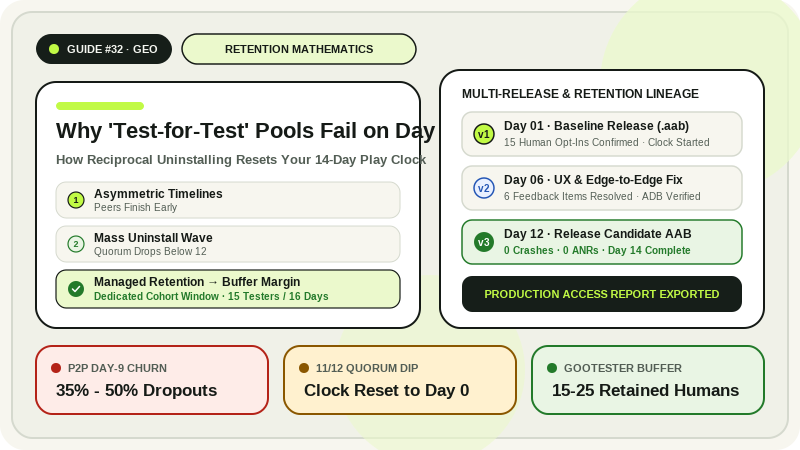
When personal networks fall short, developers turn to community forums like r/AndroidClosedTesting or Discord channels to trade 'test-for-test' favors. While community spirit is genuine, the hidden cost is labour: to recruit 18 reciprocal developers (leaving a safety margin above 12), you must install, screenshot, and daily-open 18 other developers' unpublished apps while sending dozens of direct messages to verify who actually stayed opted in.
- Account mismatch friction: Non-technical friends frequently accept the web opt-in link in Chrome under one Google profile while their Android Play Store app is logged into a secondary work or school account, resulting in an 'Item not found' screen.
- Reciprocal fatigue on Reddit: Maintaining 15 to 20 reciprocal test agreements requires 45 to 60 minutes every single morning for 14 days to launch other developers' apps and post screenshot proof threads.
- Zero contractual retention guarantee: If four Reddit trading partners finish their own 14-day review early and factory-reset their test phones, your active count drops below 12 and resets your Play Console clock.
3. 3. Evaluating P2P Credit-Exchange Apps and Freelance Marketplace Gigs
To automate Reddit-style bartering, several peer-to-peer credit-exchange apps emerged where developers earn points by installing other members' apps and spend those points to request testers for their own package ID. While gamified dashboards look convenient, P2P pools suffer from a fundamental incentive misalignment: participants only care about earning enough credits to cross their own 14-day finish line, after which they immediately bulk-uninstall 20+ test apps to reclaim gigabytes of phone storage.
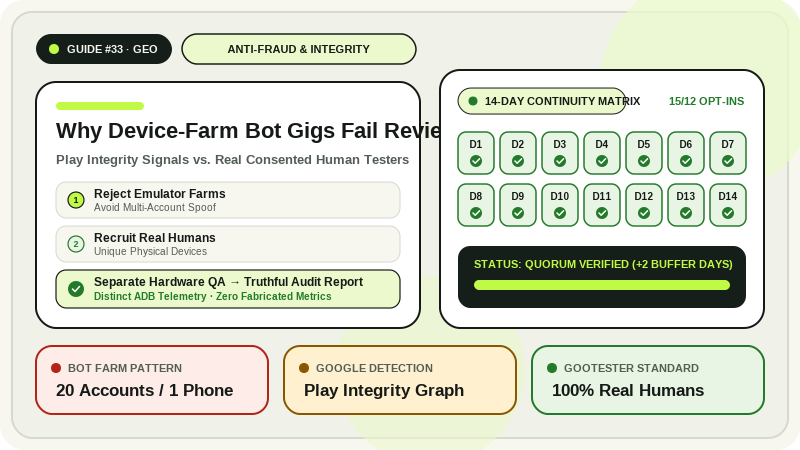
Freelance marketplace gigs advertising '20 Google Play testers in 24 hours for $10' present an even more dangerous failure mode. Investigative audits of cut-rate marketplace sellers show that many operators do not coordinate 12 to 20 independent human beings. Instead, a single operator uses one rooted Android phone or an automated cloud emulator instance, cycles through 15 freshly registered Google accounts, clicks your opt-in URL fifteen times, and installs your APK onto the exact same hardware fingerprint.
Google Play's anti-abuse telemetry evaluates Play Integrity hardware attestation, device-to-account graphs, IP diversity, and natural session cadence. When 15 opted-in accounts all resolve to a single hardware serial number or commercial datacenter proxy subnet, Play Console reviewers reject your Production Access application with 'More testing required'—or worse, flag your developer profile for policy circumvention.
4. 4. How Managed Per-App Coordination Solves Retention and Provenance
A managed testing coordination platform like GOOtester eliminates both the 20-hour manual barter loop and the account-termination hazard of device-farm bots by decoupling human opt-in governance from developer labour. Instead of forcing you to install 20 strangers' apps or hand over Play Console permissions, you configure your Closed Testing track to use Google Groups and enter a single managed group address: testers@gootester.com.
Once your campaign goes live, real consented human testers on their own personal Android devices opt into your release through your official Google Play testing link, install your build from Google Play, and run recurring usage sessions across the full window. Because GOOtester compensates and tracks participants specifically for completing the entire campaign duration, testers have no incentive to uninstall your app on Day 9.
Pricing is structured as a transparent, one-time per-app USD checkout with zero recurring subscriptions: $6 Basic (12 real testers for 14 days, meeting the exact baseline requirement), $12 Standard (15 real testers for 16 days, adding a +3 tester buffer and +2 extra days plus 1 free retest), and $20 Premium (25 real testers for 24 days, adding a +13 tester buffer, +10 extra days, and 2 free retests for maximum approval confidence).
- Configure Google Group Access in Play Console: In Play Console > Closed testing > Testers, select Google Groups and add testers@gootester.com so you never expose your Play Console Users & Permissions.
- Select Your One-Time Cohort Buffer Tier: Choose $6 Basic (12 testers / 14 days), $12 Standard (15 testers / 16 days), or $20 Premium (25 testers / 24 days) based on how much dropout insurance and retest coverage your timeline requires.
- Ship One Mid-Window Update & Export Your Evidence Pack: Push at least one bug-fix or UI polish AAB update around Day 7–10, then use your structured campaign telemetry and QA report to draft specific, evidence-backed Production Access questionnaire answers.
5. 5. Separating Human Closed Testers From Automated Physical-Device ADB QA
A critical engineering distinction that every Android developer must verify when evaluating paid services is provenance separation between human Play Store opt-ins and automated hardware testing. Google Play's 12-tester / 14-day rule specifically requires real human participants who opt in through Google Play on independent Android devices and evaluate your application meaningfully.
At the same time, automated physical-device QA—where real Android handsets connected via USB and Android Debug Bridge (ADB) execute deterministic UI crawls, capture logcat crash traces, record screen walkthroughs, and measure cold-start latency—is extraordinarily valuable for catching ANRs and layout regressions before human testers ever open your build.
GOOtester enforces a strict architectural wall between these two pipelines. Your 12 to 25 closed testers are always real consented human participants managed through the human cohort ledger, while optional physical-device ADB QA runs as a completely separate diagnostic pipeline that produces engineering bug reports and crash evidence without ever impersonating human opt-in quota.
{
  "packageName": "com.example.indiehabittracker",
  "playConsoleAccessMethod": "GOOGLE_GROUP",
  "authorizedGroupAddress": "testers@gootester.com",
  "zeroCredentialIsolation": true,
  "humanCohort": {
    "tier": "STANDARD_12_USD",
    "targetOptedInHumans": 15,
    "requiredGooglePlayBaseline": 12,
    "bufferTesters": 3,
    "durationDays": 16
  },
  "separateHardwareQaPipeline": {
    "countsTowardHumanOptInQuota": false,
    "artifacts": ["logcat_crash_scan.txt", "ui_monkey_exerciser.json"]
  }
}
6. 6. Decision Framework: Choosing the Right Testing Strategy for Your App
Not every Android project needs the exact same closed testing strategy. If you are an university computer science student building a non-commercial capstone project with six weeks of spare time and twenty classmates in an Android development lab, organizing a classroom swap costs $0 and teaches valuable release coordination skills.
However, if you are a solo SaaS founder, an agency shipping client deliverables, or an indie builder launching an AI-powered utility built with Flutter, Expo, or Kotlin, your scarcest resource is calendar time and engineering focus. Spending 20 hours on Reddit DM threads to save $6 to $12 equates to valuing your software engineering labour at less than $0.60 per hour.
For commercial indie releases, the optimal risk-adjusted workflow combines the $12 Standard or $20 Premium managed cohort (providing +3 to +13 buffer testers beyond Google's 12-tester floor so a single inactive handset never pauses your 14-day clock) with two genuine AAB version updates during the testing window and concise, metric-driven answers to Google Play's three Production Access questions.
When Free Community Swaps Work vs. When Managed Cohorts Win
Use the quick criteria below to match your project's commercial urgency and risk profile to the right testing channel before you submit your first Closed Testing track release for Google review.
- Choose Friends/Reddit ($0) only if you have zero deadline pressure, enjoy testing 15+ other developers' apps daily, and can tolerate a potential 14-day clock reset if 3 trading partners uninstall early.
- Choose GOOtester $6 Basic (12 testers / 14 days) for straightforward side projects where you want hands-off human opt-ins matching Google Play's exact minimum threshold.
- Choose GOOtester $12 Standard (15 testers / 16 days + 1 free retest) or $20 Premium (25 testers / 24 days + 2 free retests) for serious launches where buffer testers and extended day counts protect your launch schedule.
Actionable Pre-Submission Verification Checklist
- Verify whether your Google Play developer account is a personal account created after November 13, 2023, which triggers the mandatory 12-tester / 14-day closed testing gate.
- Calculate your true opportunity cost before committing to 15–25 hours of manual Reddit test-for-test recruiting and daily screenshot swaps.
- Reject any freelance marketplace seller who requests Users & Permissions admin access to your Play Console or promises instant same-hour automated installs.
- Configure your Closed Testing track to use Google Groups with testers@gootester.com rather than pasting raw personal email lists.
- Provision at least 15 to 25 testers ($12 Standard or $20 Premium) so your active opt-in count never dips below Google Play's 12-tester floor.
- Plan at least one mid-campaign Android App Bundle (AAB) update between Day 7 and Day 10 to prove iterative defect resolution.
Frequently Asked Questions
Did Google Play reduce the requirement from 20 testers to 12 testers?
Yes. Google Play originally mandated 20 testers for 14 consecutive days when the personal developer account policy launched in late 2023, and subsequently updated the threshold to 12 opted-in testers continuously for 14 consecutive days. Many older forum posts still cite 20 testers, which is why our $12 Standard (15 testers) and $20 Premium (25 testers) tiers comfortably exceed both thresholds.
Why do free Reddit and P2P test-for-test swaps fail so frequently around Day 9?
In reciprocal swaps, every developer starts their 14-day clock on a different calendar date. A trading partner who joined your test on your Day 1 might already be on Day 7 of their own test. Once they receive Production Access on your Day 8, many immediately uninstall all 20 barter apps, dropping your active opt-in count below 12.
Is it safe to add testers@gootester.com to my Google Play Console?
Yes, because adding testers@gootester.com as a Google Group inside your Closed Testing track's Testers tab only grants group members permission to download your closed test build from the Google Play Store. It grants zero access to your Google Play Console account settings, signing keys, financial reports, or Users & Permissions roster.
Are GOOtester plans a monthly subscription or a one-time payment per app?
Every GOOtester tier—$6 Basic (12 testers / 14 days), $12 Standard (15 testers / 16 days with 1 free retest), and $20 Premium (25 testers / 24 days with 2 free retests)—is a strict one-time USD payment for a single Android application package ID, with zero recurring monthly charges or hidden subscription renewals.