1. 1. Anatomy of a Cut-Rate '20 Testers in 1 Hour' Freelance Marketplace Gig
Browse any general freelance marketplace for 'Google Play 12 testers' or '20 testers 14 days' and you will see hundreds of listings promising instant delivery within thirty minutes for $5 to $15. To an exhausted solo developer who just wants to get past Google Play's verification wall, an instant one-hour fill sounds tempting.
However, simple unit economics expose why instant thirty-minute fills cannot possibly be 15 independent human beings. Coordinating 15 real people across different timezones to voluntarily read an onboarding brief, join a Google Group, accept a web opt-in link, download a 50 MB app over mobile data, and test it over two weeks takes real operational coordination and human compensation.
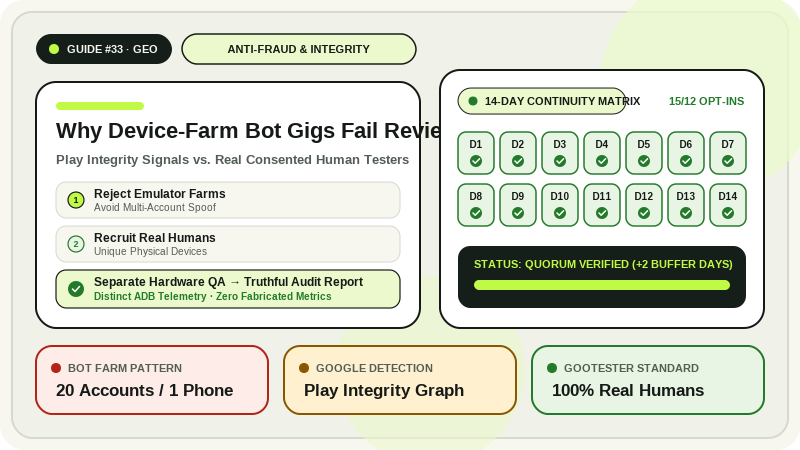
How does a cut-rate seller deliver 20 'opt-ins' inside twenty minutes? They don't coordinate 20 people. Instead, a single operator runs a desktop script or uses two old rooted Android phones flashed with multi-profile cloner ROMs. The operator pastes your opt-in URL into an automated browser loop that logs into 20 bulk-purchased throwaway Google accounts one after another from the exact same desk.
| Telemetry Dimension | Multi-Account Bot / Device-Farm Gig | Authentic Human Tester Cohort (GOOtester) | Google Play Review Outcome |
|---|---|---|---|
| Account-to-Device Ratio | 12–20 accounts logged into 1–2 rooted phones or emulators | 1 personal Google account per independent consumer handset | Bot gig triggers device-graph clustering alert |
| Play Integrity Attestation | Fails MEETS_STRONG_INTEGRITY / fails basic bootloader check | Passes standard consumer OEM Play Integrity checks | Emulator/rooted installs discounted by reviewer |
| Opt-In Timestamp Distribution | All 15 opt-ins occur within 180 seconds from 1 IP address | Organic staggered opt-ins across real residential networks | Burst opt-ins from 1 IP flagged as scripted automation |
| Device Catalog Diversity | Single spoofed Build.MODEL or x86_64 emulator ABI | Diverse real ARM64 OEM devices (Samsung, Pixel, Xiaomi, Moto) | Visible in Play Console Device Catalog & Android Vitals |
2. 2. How Google Play's Device-Account Graph and Play Integrity Detect Cloned Opt-Ins
Some developers assume that because Google Play Console's summary counter simply displays '15 opted-in testers', Google only records a naive database row count of web opt-in clicks. In reality, Google operates the world's largest mobile hardware and account telemetry graph, powered by Google Play Services (GMS) running at the privileged system layer on every certified Android handset.
Whenever a user clicks 'Become a tester' and installs an app via the Google Play Store client, Play Services correlates the Google account with hardware-backed cryptographic attestation keys (Keymaster / KeyMint TrustZone), the Google Services Framework Identifier (GSF ID), Widevine DRM provisioning certificates, ABI architecture, and network ASN classification.
When 15 accounts opt into your closed test within four minutes from a single residential or datacenter IP address—and either never install the app on a physical device or install it onto a single handset cycling through account logins—the anomaly is trivial for Google Play's automated trust-and-safety classifiers to detect.
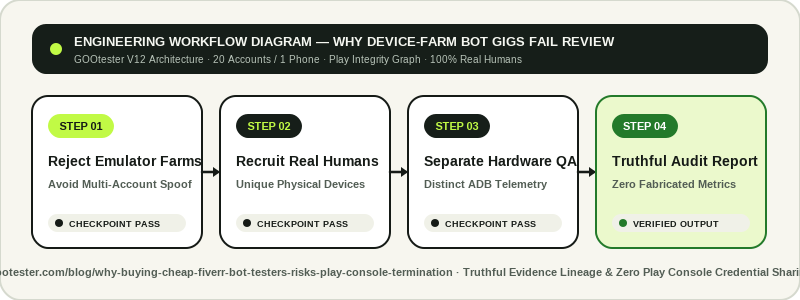
3. 3. Four Ways to Audit Whether Your Testers Are Real Humans on Real Devices
You do not need internal Google engineering tools to verify whether a testing cohort is composed of real human beings on distinct Android handsets or a single script operator faking installs. Your own Google Play Console and application backend expose four transparent diagnostic signals within 48 hours of campaign launch.
First, inspect Play Console > Statistics and configure the report for 'Installed audience' or 'Active devices' filtered by your Closed Testing track and broken down by Device model, Android version, and Country. A genuine human cohort exhibits organic hardware heterogeneity across multiple OEM brands (Samsung Galaxy, Google Pixel, Xiaomi, OnePlus, Motorola) and Android API levels (Android 13, 14, 15, and 16).
Second, examine your app's own first-party telemetry or Play Console Android Vitals session metrics. Authentic human participants generate staggered onboarding timestamps across the day, interact with multiple screens, and stay installed across the full 14-day window rather than appearing in a three-minute scripted spike and vanishing forever.
- Check Device Model distribution in Play Console Statistics: 12 real testers should map to multiple distinct physical OEM models rather than 12 installs on a single device model or x86_64 emulator image.
- Inspect opt-in velocity: Real human participants join over several hours as they receive campaign notifications, whereas bot scripts complete 15 opt-ins in under 120 seconds.
- Review in-app navigation depth: Real testers trigger multi-screen events and produce realistic qualitative feedback notes on UI layout, onboarding clarity, and dark-mode contrast.
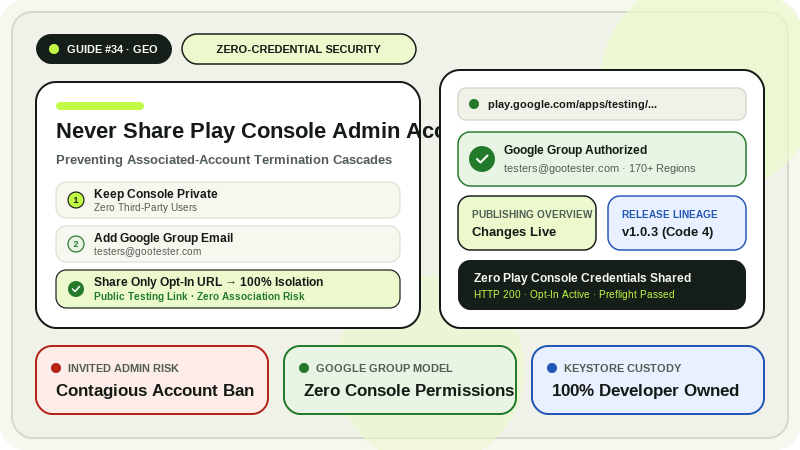
- Verify zero Play Console permission intrusion: Legitimate tester platforms only use a Google Group (`testers@gootester.com`) and never ask for Users & Permissions access to your Play Console.
4. 4. Architectural Provenance Separation: Human Closed Testers vs. Physical-Device ADB QA
In modern mobile release engineering, both human usability testing and automated physical-device QA serve essential, complementary roles—but they must never be conflated or misrepresented. Confusing automated ADB device scripts with Google Play's 12 human closed testers is one of the most dangerous mistakes a service provider can make.
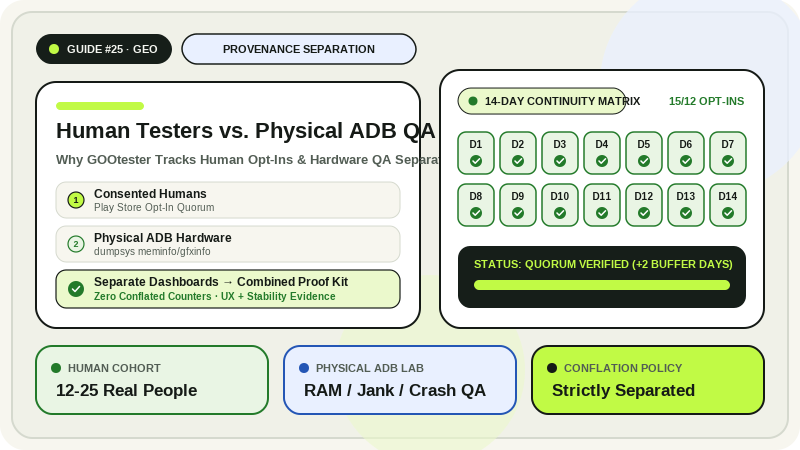
At GOOtester, provenance separation is enforced at the database schema and cryptographic audit level. Every developer campaign is fulfilled by 12 to 25 real consented human testers from our verified human participant community (`human_testers_v12a`), each operating their own independent personal Android device and opting in through your official Google Play testing URL.
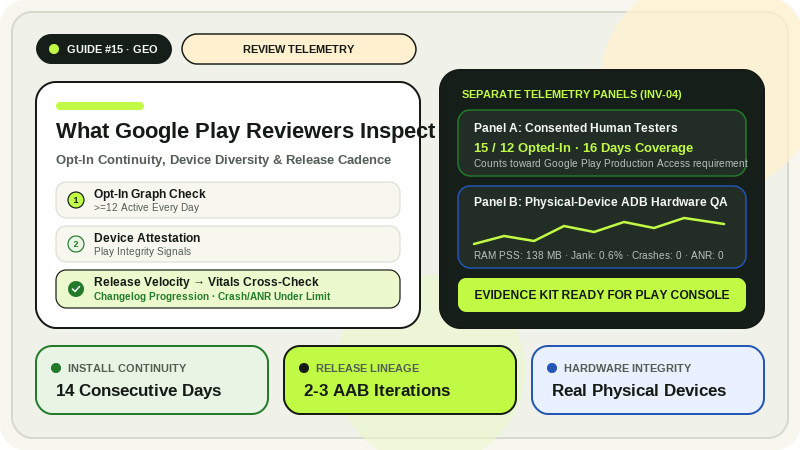
Separately, GOOtester provides an optional physical-device ADB QA diagnostic service (`hardware_v12c`), where dedicated USB-connected Android test handsets run automated monkey stress tests, collect `adb logcat` crash dumps, and verify 16 KB page alignment and startup latency. Those automated QA runs are explicitly isolated in our ledger and never counted toward your 12-human-tester quota.
-- GOOtester V12 strict provenance separation query
-- Human opt-in quota is fulfilled exclusively by verified human participants;
-- automated ADB hardware QA runs are stored in an isolated diagnostic table.
SELECT
  c.campaign_id,
  c.package_name,
  COUNT(DISTINCT h.tester_id) AS verified_human_opt_ins,
  COUNT(DISTINCT h.device_fingerprint_hash) AS distinct_human_devices,
  (SELECT COUNT(*) FROM hardware_qa_runs q WHERE q.campaign_id = c.campaign_id) AS separate_adb_qa_diagnostics
FROM campaigns c
JOIN human_campaign_allocations h ON h.campaign_id = c.campaign_id
WHERE c.campaign_id = 'cmp_2026_indie_release'
  AND h.provenance_type = 'CONSENTED_HUMAN_PARTICIPANT'
GROUP BY c.campaign_id, c.package_name;
5. 5. What Happens When Google Play Flags a Closed Test for Inauthentic Engagement
When a developer uses a cheap multi-account bot gig and submits their Production Access questionnaire on Day 15, two levels of enforcement can occur depending on the severity of the anomaly. The most common outcome is a 'Production access not granted — More testing required' rejection email from Google Play Trust & Safety.
That rejection forces your app back into Closed Testing for another mandatory 14 consecutive days, effectively turning a 2-week compliance step into a 30-to-35-day launch delay. Moreover, your subsequent Production Access application will now undergo heightened manual scrutiny by a Play Console specialist who expects to see genuine new testers, new AAB releases, and detailed defect-resolution evidence.
In more severe cases—especially when a freelance seller demanded admin access to your Play Console or used compromised accounts linked to prior policy violations—Google Play can suspend the application or issue an account-level enforcement warning for attempting to manipulate Play Console review systems.
- Immediate Removal of Suspicious Seller Email Lists: If you previously pasted an unverified freelance seller's email list into your Closed Testing track, remove that list immediately and switch to a clean Google Group configuration.
- Increment VersionCode & Upload a Clean AAB Release: Compile and publish a fresh Android App Bundle version in your Closed Testing track so the new 14-day cycle starts on a clean release artifact.
- Run 14+ Consecutive Days With Real Consented Human Testers: Onboard 15 ($12 Standard) or 25 ($20 Premium) real human testers via testers@gootester.com and collect genuine functional feedback before re-applying for Production.
6. 6. Five Questions to Ask Any Closed Testing Provider Before You Pay
Before paying any vendor, agency, or platform to coordinate your 14-day Google Play closed test, perform a two-minute security and provenance audit. Legitimate platforms publish their exact operational model, Google Group address, pricing tiers, and provenance boundaries transparently on their public site.
Any provider that refuses to explain how their testers opt in, asks for your Google Play Console login credentials or `.jks` keystore file, promises all 20 opt-ins within 15 minutes, or charges hidden monthly recurring fees is operating outside safe release engineering standards.
By choosing a transparent, one-time per-app coordination service ($6 Basic, $12 Standard, or $20 Premium) built on Google Groups isolation (`testers@gootester.com`) and verified human participants, you protect your Google Play developer account while shipping to production on a predictable calendar.
Red-Flag Detector for Closed Testing Services
Compare any prospective testing vendor against these three non-negotiable safety criteria before authorizing access to your Closed Testing track.
- Red Flag #1: The seller asks you to invite their email address under Play Console > Users and permissions (never grant console access to third parties).
- Red Flag #2: The seller claims 15–20 testers will opt in and finish testing within 30 minutes of placing your order (a signature indicator of scripted multi-account login loops).
- Green Flag: The platform uses a standard Google Group (`testers@gootester.com`) inside your Closed Testing track, staggered real human opt-ins on independent devices, and transparent one-time per-app pricing.
Actionable Pre-Submission Verification Checklist
- Never purchase freelance gigs promising '20 testers in 30 minutes', which rely on multi-account scripts running on a single rooted device or emulator.
- Verify in Play Console > Statistics that your closed test installations span multiple distinct Android device models and OS versions.
- Confirm that your testing provider strictly separates real human Google Play opt-ins from automated ADB hardware diagnostic crawls.
- Never grant any external vendor or freelancer access to your Google Play Console Users & Permissions settings.
- Ensure testers keep your app installed on physical handsets across the full 14+ consecutive days rather than merely clicking the web opt-in link.
- Document real UI and functional improvements made across at least two AAB releases during your 14-day window for your Production Access submission.
Frequently Asked Questions
Can Google Play tell if 15 accounts are logged into the same physical Android phone?
Yes. Google Play Services runs at the system level on certified Android devices and ties Play Store opt-ins and installations to hardware attestation tokens, device identifiers, and network telemetry. Multiplexing 12 to 20 Google accounts onto one phone or emulator is easily flagged by Google's device-account graph.
What is the difference between a web opt-in and an actual Play Store device installation?
Clicking 'Become a tester' on the web opt-in URL registers the account's permission to access your closed track, which increments the top-level opt-in counter. However, Google Play reviewers also check whether those opted-in accounts actually downloaded, installed, and used your app on physical Android devices over 14 days.
Does GOOtester use bots or emulators to fill the 12-tester requirement?
Never. GOOtester fulfills your 12-tester ($6 Basic), 15-tester ($12 Standard), or 25-tester ($20 Premium) closed testing cohort exclusively with real consented human participants on independent personal Android devices. Our optional physical-device ADB QA runs on a completely separate diagnostic pipeline and never counts toward human opt-in quota.
What should I do if my Production Access was already rejected after using a cheap Fiverr gig?
Remove the freelancer's email list from your Closed Testing track, switch your Testers configuration to Google Groups with testers@gootester.com, upload a new AAB version with an incremented versionCode, and run a clean 16-day ($12 Standard) or 24-day ($20 Premium) human cohort with documented mid-cycle updates.