1. 1. The Asynchronous Timeline Problem in P2P Tester Exchanges
At first glance, peer-to-peer 'test-for-test' credit exchange apps look like a clever solution for indie Android developers. You install an exchange wrapper app, test ten other developers' unreleased apps to earn virtual credits, and spend those credits so twelve developers install your closed test build. Everyone gets free testing, and nobody pays cash.
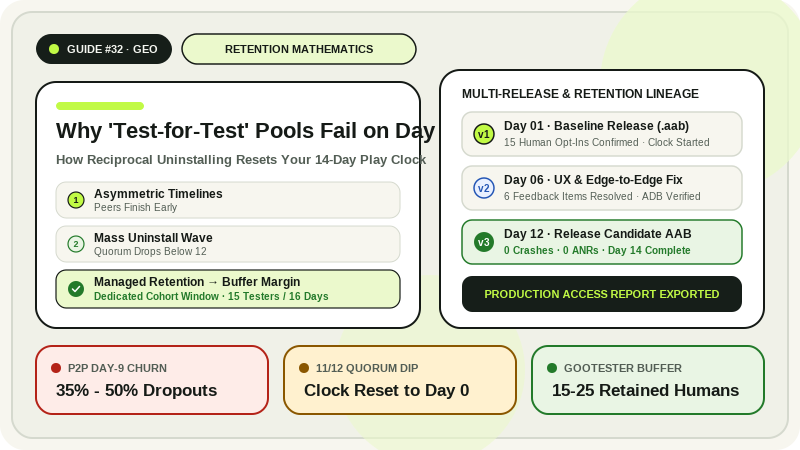
The fatal flaw in this barter economy is timeline misalignment. Every developer inside a P2P credit pool starts their 14-day Google Play closed testing window on a different calendar day. When Developer B joins your closed test on your Day 1 to earn credits for their final push, Developer B is often already on Day 6 or Day 8 of their own 14-day review cycle.
Seven days later—when you are celebrating reaching Day 8 or Day 9 of your closed test—Developer B crosses Day 14, submits their Production Access request, and gets approved by Google Play. At that exact moment, Developer B has 25 unfamiliar beta apps cluttering their personal daily-driver phone, draining background battery, and consuming 4 GB of flash storage. Their immediate next action is a mass uninstall.
| Your Campaign Day | Barter Partner's Own Day | Barter Partner's Incentive State | Typical Action Taken on Phone | Impact on Your Play Console Clock |
|---|---|---|---|---|
| Day 1 | Day 7 of their test | High (needs credits to keep top ranking) | Opts in and installs your app | Your opted-in count reaches 12/12 |
| Day 5 | Day 11 of their test | Moderate (checking daily credit balance) | Briefly opens app for 10 seconds | Your count holds at 12/12 (Day 5 complete) |
| Day 8 | Day 14 of their test (Done!) | Zero (Production Access unlocked) | Leaves Google Group & uninstalls 20 test apps | Your count drops to 9/12; 14-day streak breaks |
| Day 10 | Post-launch | Unreachable (deleted exchange app) | Ignores DMs asking to re-install | You must recruit replacement testers & restart |
2. 2. The Mathematics of 14-Day Cohort Survival Without Buffer Testers
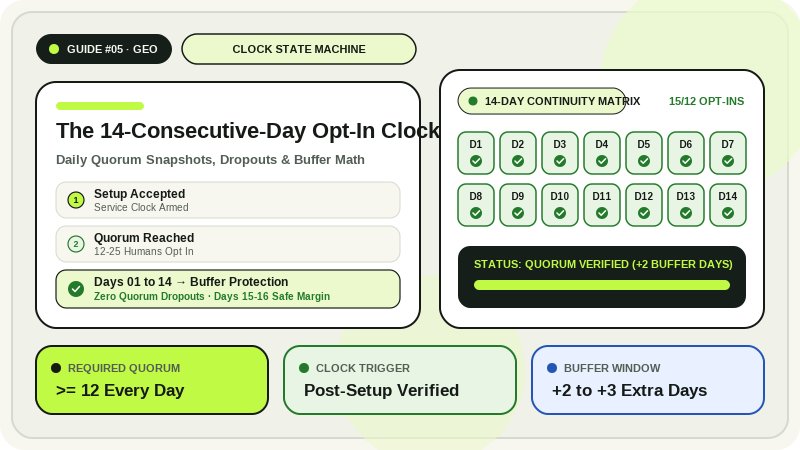
Many developers underestimate how fragile an exact 12-tester cohort really is across 336 continuous hours. Because Google Play requires at least 12 testers to remain opted in for 14 consecutive days, having exactly 12 testers means your fault tolerance is zero. A single person leaving your testing program, switching Android phones, or revoking their opt-in link breaks the threshold.
We can model 14-day cohort completion using the binomial survival distribution. Suppose each uncompensated barter tester has a modest 2.5% probability on any given day of churning (leaving the test or uninstalling after their own app passes review). Across a 14-day window, an individual barter tester's cumulative retention probability is roughly p = (0.975)^14 ≈ 0.701, or 70.1%.
If you recruit exactly N = 12 barter testers with a 70.1% 14-day survival rate, the probability that all 12 remain active through Day 14 is (0.701)^12 = 0.014, or just 1.4%. Even if individual 14-day retention in a well-moderated community rises to 85%, a zero-buffer 12-tester cohort still only has a (0.85)^12 = 14.2% chance of finishing without a single dropout. Buffer capacity is not a luxury; it is a mathematical necessity.
// Compute probability that at least 12 testers survive all 14 days
function binomialCoeff(n, k) {
  let res = 1;
  for (let i = 1; i <= k; i++) res = (res * (n - i + 1)) / i;
  return res;
}

function probabilityAtLeast12(totalTesters, fourteenDayRetentionProb) {
  let sum = 0;
  for (let k = 12; k <= totalTesters; k++) {
    sum +=
      binomialCoeff(totalTesters, k) *
      Math.pow(fourteenDayRetentionProb, k) *
      Math.pow(1 - fourteenDayRetentionProb, totalTesters - k);
  }
  return (sum * 100).toFixed(2) + "%";
}

// P2P Barter (p = 0.75 over 14 days) vs Managed Synchronized Cohort (p = 0.96)
console.log("12 P2P testers (0 buffer, p=0.75):", probabilityAtLeast12(12, 0.75)); // 3.17%
console.log("15 Managed testers (+3 buffer, p=0.96):", probabilityAtLeast12(15, 0.96)); // 99.78%
console.log("25 Managed testers (+13 buffer, p=0.96):", probabilityAtLeast12(25, 0.96)); // 99.9999%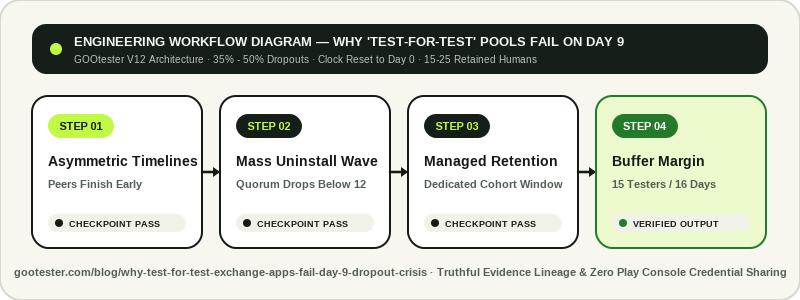
3. 3. Why Play Console's 24–48 Hour Telemetry Lag Masks Dropouts Until Day 11
What makes the Day-9 P2P dropout crisis particularly painful is that Google Play Console does not stream closed tester opt-in counts in real time. The Closed Testing track statistics widget and the Dashboard Production Access milestone tracker batch-update on an asynchronous 24-to-48-hour reporting cycle harmonized against Pacific Time (UTC-8/UTC-7).
When three barter partners uninstall your app and opt out on Tuesday afternoon (your Day 9), your Play Console overview often continues displaying '12 opted-in testers' throughout Wednesday. You only discover the dip on Thursday morning (Day 11), after two full UTC calendar days have already been recorded below the 12-tester compliance line.
By the time you scramble back into the P2P exchange app or Reddit thread to beg three new replacements to opt in, and wait another 24 hours for their opt-in events to propagate into Play Console's batch warehouse, your consecutive 14-day window has been broken—costing you nearly two weeks of launch delay.
4. 4. The '10-Second Credit Check-In' Pattern That Triggers Engagement Rejections
Even when P2P exchange apps attempt to enforce retention by requiring users to open each installed app for 10 to 15 seconds every day to claim daily points, the resulting telemetry pattern looks synthetic to Google Play's review heuristics. Think about how a developer farming credits behaves: they tap through 20 apps in a row, leave each splash screen open for 15 seconds without touching a single button, and force-close the app.
When a Play Console reviewer or automated quality gate inspects your Closed Testing track after 14 days, they do not merely check a boolean flag for 12 opt-ins. They evaluate whether real testers actually exercised your application's core user journeys, triggered multi-screen navigation flows, generated realistic session durations, and tested at least one updated version release.
Twenty identical 12-second splash-screen opens with zero screen transitions and zero follow-up feedback leave you with nothing substantive to write in your mandatory Production Access application form—leading directly to the dreaded 'More testing required' rejection notice on Day 15.
- Zero screen depth: Credit farmers rarely log past your onboarding screen or create sample data inside your app because they are cycling through two dozen apps before breakfast.
- No actionable bug reports: When Google Play asks 'What changes did you make to your app based on what you learned during your closed test?', P2P credit swaps leave you without genuine defect logs.
- Package scraping exposure: Public P2P directories expose your unreleased app's package name, store listing screenshots, and positioning to hundreds of anonymous scrapers before your official launch.
5. 5. How Synchronized Cohorts and Buffer Tiers Eliminate Mid-Cycle Churn
Solving the Day-9 dropout crisis requires changing both the cohort structure and the participant incentive model. Instead of matching asynchronous developers who leave as soon as their own app is approved, GOOtester provisions a synchronized cohort of consented human testers whose assignment is explicitly anchored to your campaign's start date and full duration.
Equally important is engineering redundancy above Google Play's 12-tester baseline. Just as production cloud infrastructure runs N+3 server redundancy so a hardware fault never causes downtime, running a closed test with 15 or 25 testers ensures that if one or two human participants lose their phone or go offline while traveling, your active opted-in floor stays solidly at 13+ or 23+ for every single hour of the 14-day window.
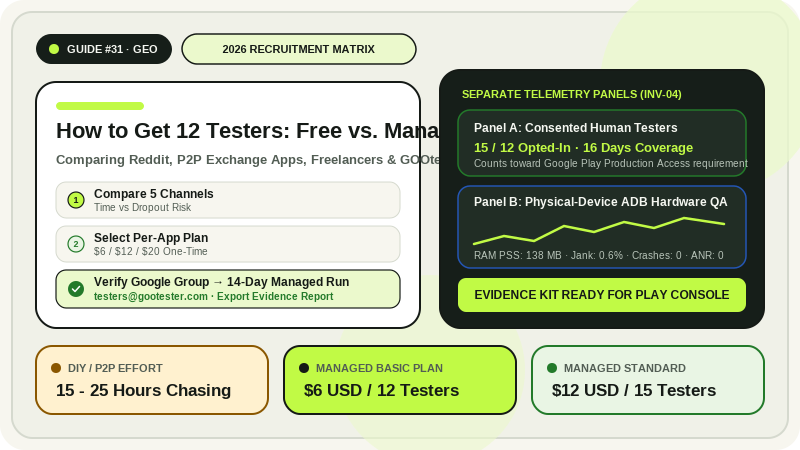
GOOtester's three one-time per-app tiers let you choose your exact redundancy margin: $6 Basic allocates 12 testers for 14 days; $12 Standard allocates 15 testers (+3 buffer) for 16 days (+2 buffer days) and includes 1 free retest; and $20 Premium allocates 25 testers (+13 buffer) for 24 days (+10 buffer days) with 2 free retests.
- Anchor All Testers to Your Campaign Day 1: Every tester in your GOOtester cohort is assigned to your specific 14-to-24-day window rather than running on an unrelated developer's schedule.
- Maintain a +3 to +13 Tester Headroom Buffer: With 15 ($12 Standard) or 25 ($20 Premium) opted-in human testers, normal human life events never drop your Play Console active count below the mandatory 12-tester floor.
- Run +2 to +10 Extra Buffer Days Beyond Day 14: Extending retention to 16 or 24 days completely absorbs Google Play Console's 24–48 hour UTC timezone batch reporting delay.
6. 6. Recovery Protocol If Your P2P or Reddit Cohort Already Dropped Below 12
If you are currently in the middle of a free Reddit swap or P2P exchange campaign and just noticed your opted-in tester count slip from 12 down to 9 or 10, do not panic—and do not delete your Closed Testing track or create a new package ID. Your existing package name, keystore configuration, and store listing can be preserved cleanly.
To stabilize your track immediately, switch your Closed Testing > Testers configuration in Play Console to Google Groups (or add `testers@gootester.com` to your authorized Google Groups list) and save changes in Publishing Overview. Existing testers who are still opted in via your opt-in URL remain opted in as long as their group or authorization remains valid.
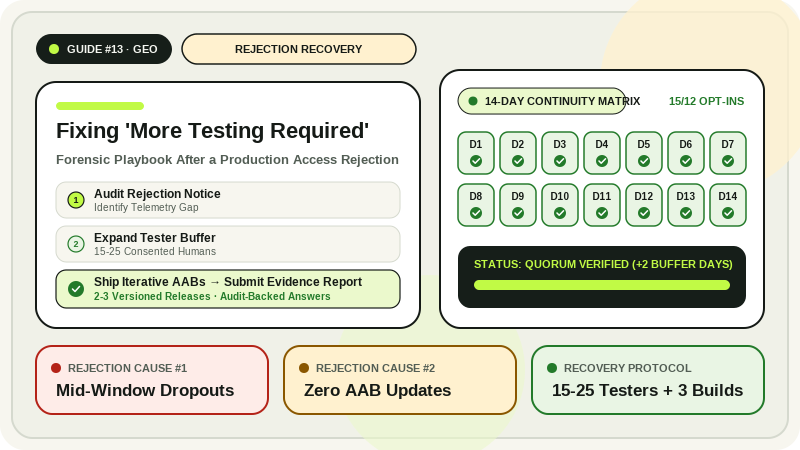
Once a buffered cohort of 15 or 25 managed testers opts in, your active count will surge past 12 and hold steady through the full 14+ consecutive days. Use the fresh window to ship a point-release AAB update with tangible release notes so your eventual Production Access submission demonstrates both rock-solid tester retention and responsive engineering iteration.
Immediate Triage Steps When Your Opt-In Count Drops
Execute these three steps in your Google Play Console before recruiting replacement testers so you do not lose existing installation continuity.
- Do not unpublish or create a duplicate Closed Testing track; keep your primary track active so existing installations stay valid.
- Add testers@gootester.com under Closed testing > Manage track > Testers > Google Groups and confirm the change is live without pending Publishing Overview holds.
- Bump versionCode in build.gradle.kts, upload an updated AAB during the new 14-day streak, and document the fixes for your Production Access form.
Actionable Pre-Submission Verification Checklist
- Audit your active Play Console Closed Testing opt-in count against the mandatory 12-tester floor rather than relying on verbal promises in Reddit threads.
- Never run a commercial launch with zero buffer testers (exactly 12/12) when using uncompensated community or P2P barter participants.
- Account for Google Play Console's 24–48 hour UTC batch reporting lag by keeping your cohort opted in for at least 16 consecutive days.
- Verify that testers remain both opted in on the web testing link and actively installed on physical Android handsets across the full window.
- Ship at least one updated Android App Bundle (AAB) mid-window so returning testers generate multi-version upgrade telemetry.
- Use a synchronized buffer tier ($12 Standard for 15 testers / 16 days or $20 Premium for 25 testers / 24 days) to prevent asynchronous Day-9 dropouts.
Frequently Asked Questions
What happens in Google Play Console if my tester count drops from 12 to 11 on Day 10?
Google Play requires 12 testers to be continuously opted in for 14 consecutive days. If your active opted-in count drops below 12 before the 14 full days are recorded, the consecutive-day milestone pauses or resets until your active count climbs back to at least 12 and completes 14 uninterrupted days.
Does a tester uninstalling the app count as opting out?
Even if a tester leaves their web opt-in toggle active after uninstalling your app from their device, Google Play reviewers inspect active device installation retention and engagement metrics when evaluating your Production Access request. High mid-window uninstall rates frequently cause 'More testing required' rejections.
How many buffer testers should I add above Google Play's 12-tester requirement?
For reliable single-cycle completion, we recommend a minimum buffer of +3 testers and +2 extra days (15 testers for 16 days in GOOtester's $12 Standard plan), or +13 testers and +10 extra days (25 testers for 24 days in the $20 Premium plan) for time-critical commercial releases.
Can I add GOOtester's Google Group to an existing Closed Testing track after a P2P dropout?
Yes. You can add testers@gootester.com under the Google Groups section of your existing Closed Testing track at any time, publish the track update, and immediately onboard a synchronized cohort of 12, 15, or 25 real human testers without changing your app's package name.