1. 1. The November 13, 2023 Policy Shift: Why Google Introduced the 20-Tester Gate
On November 13, 2023, Google Play enacted the most significant structural change to independent Android publishing in over a decade. Facing an exponential surge in low-effort template uploads, ad-fraud shells, and untested webviews submitted through newly registered $25 individual accounts, Google bifurcated Play Console onboarding into Personal Developer Accounts and Organization Developer Accounts.
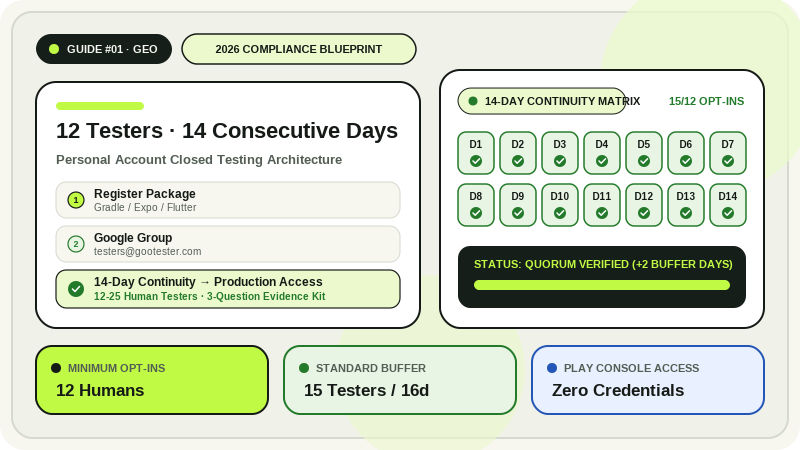
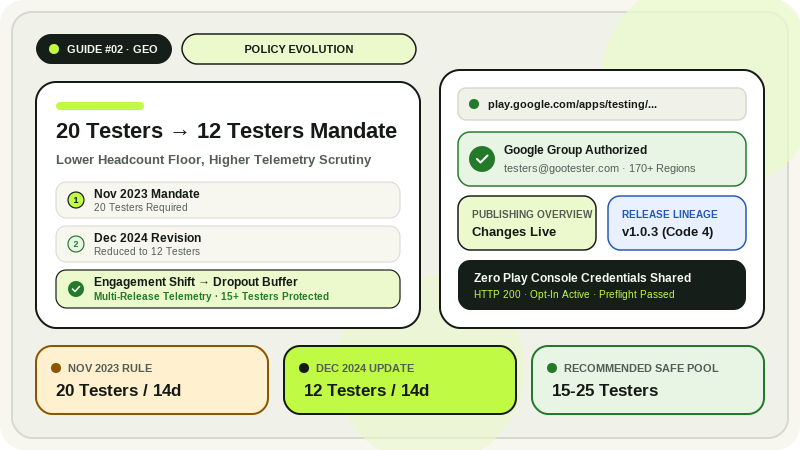
Under that original November 2023 framework, any Personal Developer Account created on or after the cutoff date was required to recruit at least 20 distinct testers who remained opted in to a Closed Testing track for 14 continuous days. The goal was to ensure that every independent developer assembled a sizeable beta cohort capable of exposing crashes, broken layouts, and policy violations prior to public Store indexing.
While the policy succeeded in filtering out automated spam farms, the 20-tester threshold quickly created an unintended bottleneck for legitimate solo engineers, computer science students, and micro-SaaS founders. Recruiting 20 people who owned Android devices, were willing to share their Google email addresses, and remembered to keep an unreleased app installed for two full weeks proved notoriously difficult.
| Policy Dimension | Original Nov 2023 Mandate | Current 2026 Mandate | Engineering Impact |
|---|---|---|---|
| Minimum Opted-In Testers | 20 unique Google accounts | 12 unique Google accounts | 40% reduction in baseline headcount floor |
| Mandatory Testing Duration | 14 consecutive days | 14 consecutive days | Unchanged strict continuity requirement |
| Eligible Testing Track | Closed Testing only | Closed Testing only | Internal & Open tracks still excluded |
| Engagement & Iteration Audit | Basic opt-in count check | High scrutiny on AAB updates & retention | Static single-build tracks frequently rejected |
| Per-Tester Weight in Minimum Pool | 5.0% per tester (1/20) | 8.33% per tester (1/12) | Single dropout has higher proportional impact |
2. 2. Why and When Google Lowered the Requirement from 20 Testers to 12 Testers
In December 2024, after analyzing a full year of Play Console graduation telemetry, Google officially revised the closed testing headcount requirement downward from 20 testers to 12 testers for 14 consecutive days. Play Console UI banners, Help Center documentation, and the Dashboard compliance tracker were updated globally to reflect the new 12-tester baseline.
Google's internal data revealed an important statistical insight: once a closed test reaches 12 diverse physical Android devices across multiple OS versions and screen densities, the vast majority of crash-on-launch defects, missing runtime permissions, and ProGuard/R8 obfuscation errors surface within the first two weeks. Forcing solo developers to find eight additional testers beyond 12 yielded diminishing diagnostic returns while fueling fragile 'test-for-test' exchange communities.
Crucially, when Google reduced the threshold from 20 testers to 12 testers, any app already in the middle of a closed testing cycle with 12 or more active testers immediately qualified under the new counter math. However, the 14-day consecutive duration rule remained completely intact—meaning 12 testers for 13 days still leaves the Production Access button locked.
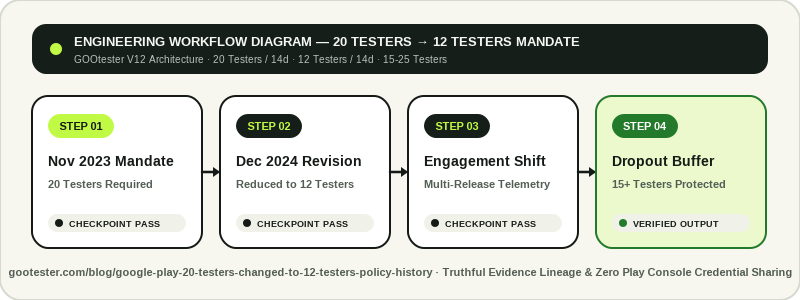
3. 3. Fewer Testers, Higher Scrutiny: How Google Tightened Telemetry Enforcement
Many developers falsely assumed that dropping the requirement from 20 testers to 12 testers meant Google was relaxing enforcement. In reality, the exact opposite occurred. By lowering the numerical barrier to a realistic 12-person cohort, Google Play's Trust and Safety engineering team shifted enforcement weight from raw headcount toward qualitative engagement telemetry and release hygiene.
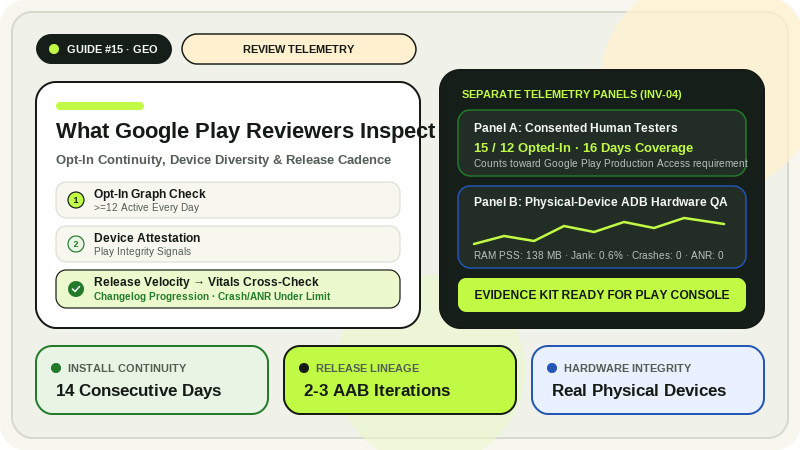
During the early 20-tester era, some developers bypassed the spirit of the rule by getting 20 accounts to click the web opt-in link without ever downloading the binary onto a physical handset, or by installing the app and uninstalling it five minutes later. Today, Play Console's backend correlates web opt-in grants against real Google Play Store client installation events, device diversity signatures, and active package presence across the 14-day window.
If 12 accounts accept your web opt-in link from a single data-center IP block or never complete a Play Store binary installation on real Android hardware, the Play Console dashboard may either refuse to increment the 14-day counter or flag the subsequent Production Access submission for manual rejection under the 'More testing required' decision code.
- Web Opt-In vs. Play Client Install: Clicking 'Become a tester' in a browser is insufficient if the tester never installs the AAB through the Google Play Store app.
- Retention Continuity: Immediate uninstalls after initial download signal superficial compliance and weaken your Production Access review profile.
- Release Iteration Signal: Reviewers inspect whether you published at least one bug-fix or polish update during the 14-day cycle.
- Questionnaire Consistency: Your narrative answers must align with actual Play Console release dates, version codes, and crash reports.
4. 4. Why 'Test-for-Test' Subreddits and Discord Groups Struggle Under the 12-Tester Rule
During the 20-tester era, informal developer bartering groups emerged on Reddit, Discord, and Telegram where indie developers promised to install each other's apps. Paradoxically, the transition to 12 testers made relying on these unverified barter rings even riskier fordevelopers aiming solely for the bare minimum headcount.
In a 12-tester minimum pool, every single participant represents 8.33% of your compliance threshold. When a developer recruits exactly 12 strangers from a free exchange board, it only takes one participant flashing a custom ROM, clearing their Play Store account, or uninstalling your app on Day 9 to drop your active count to 11 and stall your 14-day clock.
Furthermore, reciprocal testing exchanges rarely yield coherent bug reports for a single app domain, and participants frequently batch-install thirty unrelated apps in ten minutes without opening them again. That behavioral footprint contrasts sharply with managed, verified human tester cohorts that remain opted in across the entire compliance window.
// Probability of completing 14 consecutive days with >= 12 active testers
// when daily individual volunteer dropout rate p = 0.015 (1.5% per day)
function survivalProbability(initialTesters, requiredTesters = 12, days = 14, dailyDropout = 0.015) {
  const singleTesterRetention = Math.pow(1 - dailyDropout, days);
  // Exact 12-tester pool has zero fault tolerance: all 12 must survive 14 days
  if (initialTesters === requiredTesters) {
    return Number(Math.pow(singleTesterRetention, requiredTesters).toFixed(4));
  }
  return { singleTesterRetention: Number(singleTesterRetention.toFixed(4)), bufferTesters: initialTesters - requiredTesters };
}
// Output for exact 12 volunteers at 1.5%/day churn: ~0.0791 (only 7.9% chance zero testers drop!)
5. 5. The Mathematical Case for Running 15 to 25 Testers in a 12-Tester World
From a release engineering standpoint, treating a statutory minimum as your operational target is an anti-pattern. Just as backend architects provision server capacity above peak minimum traffic to handle node failures, experienced Android publishers provision 15 to 25 opted-in testers even though Google Play's gate checks for 12.
When Google lowered the requirement from 20 to 12, developers who continued deploying 15 testers ($12 Standard package) or 25 testers ($20 Premium package) gained a massive structural advantage. Instead of needing 20 testers just to break even on the old policy, a 25-tester cohort today provides a 108% safety margin (+13 buffer testers) above the 12-tester floor.
Additionally, over-provisioning duration—running 16 consecutive days on the $12 Standard tier or 24 consecutive days on the $20 Premium tier—ensures that your tester pool stays fully active not only during the 14-day counter accrual, but also across the 2 to 5 extra days when a human Google Play reviewer is actively inspecting your track to approve Production Access.
6. 6. How to Audit Which Policy Rule Applies to Your Play Console Account
If you registered your Google Play Developer Account several years ago or recently migrated an app between accounts, you can verify whether the 12-tester mandate applies to your specific project directly from the Play Console home workflow. Open your application, navigate to the Dashboard tab, and scroll to the 'Set up your app' or 'Release your app' progress module.
If your account is a Personal Developer Account created after November 13, 2023, you will see a dedicated compliance checklist card titled 'Run a closed test with at least 12 testers for at least 14 days'. That progress widget displays both the current number of opted-in testers detected on your Closed Testing track and the number of consecutive days completed out of 14.
Regardless of whether you are launching your very first app or migrating from an old 20-tester workflow, configuring `testers@gootester.com` in your Closed Testing Google Groups field and selecting a buffered GOOtester tier aligns your release pipeline with Google Play's latest 2026 compliance standards.
- Check Dashboard Compliance Card: Open Play Console > Select App > Dashboard and inspect the Production readiness panel for the 12-tester, 14-day progress counter.
- Remove Stale CSV Email Lists: If you previously attempted an informal test with dead email lists, switch your Closed Testing track to Google Groups mode and bind testers@gootester.com.
- Select a Buffered Compliance Tier: Choose the $6 Basic (12 testers/14d), $12 Standard (15 testers/16d), or $20 Premium (25 testers/24d) package to guarantee uninterrupted 14-day completion.
Actionable Pre-Submission Verification Checklist
- Verify that your Play Console Dashboard displays the current 12-tester, 14-day progress bar rather than relying on outdated 20-tester blog guides.
- Confirm all testers actually download and install your app from Google Play Store rather than only clicking the browser opt-in button.
- Provision at least 15 testers ($12 Standard) or 25 testers ($20 Premium) so that each tester does not represent a single point of failure.
- Keep your tester pool opted in beyond Day 14 while Google Play reviewers evaluate your Production Access questionnaire.
- Publish at least one iterative AAB update (`versionCode` bump) during the two-week window to align with heightened engagement scrutiny.
- Use testers@gootester.com via Google Groups so you never expose Play Console account credentials or private email rosters.
Frequently Asked Questions
Is the Google Play requirement 12 testers or 20 testers in 2026?
The official requirement in 2026 is 12 testers opted in continuously for 14 consecutive days. Google originally launched the policy in November 2023 requiring 20 testers, then lowered the statutory minimum to 12 testers in late 2024 while keeping the 14-day consecutive duration rule unchanged.
Did Google make Production Access easier to pass when lowering the count from 20 to 12?
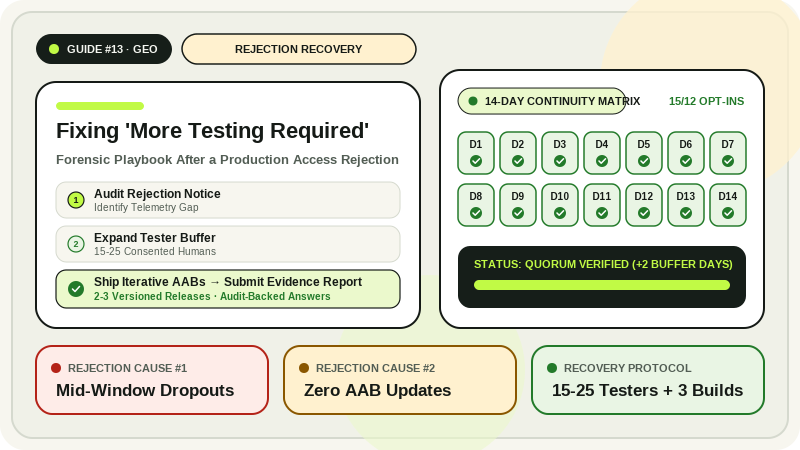
Recruiting the minimum headcount became simpler, but Production Access review scrutiny actually became stricter. Google Play reviewers now pay closer attention to real Play Store client installations, 14-day retention continuity, iterative AAB updates during the test, and detailed answers to the three mandatory Production Access questions.
If I already have 8 friends testing my app, should I just find 4 more volunteers?
Relying on an exact count of 12 informal volunteers is risky because each person accounts for 8.33% of the threshold. If even one friend changes phones or uninstalls the app before Day 14, your counter stalls. Running a dedicated 12, 15, or 25 tester cohort through testers@gootester.com ensures deterministic continuity.
Why does GOOtester offer a 25-tester package ($20) if only 12 testers are required?
Our $20 Premium package assigns 25 real human testers for 24 consecutive days—providing more than double the required tester headcount (+13 buffer testers) and 10 extra days of active coverage. That completely eliminates dropout risk and keeps your closed track populated while Google reviews your Production Access request.